Payne's Pathway. . .


In one week we will proudly carry the prayer flag of many great and amazing people on a journey to the top of Mt. Kilimanjaro. This journey will have many obstacles and difficulties. Often, cancer patients describe their cancer journey as if they were climbing a gigantic mountain, listen to Pamela's journey, she is an inspiration to us!! In her own words: 
 "October 19th, 2012 started off like any other day. That evening, after I finished nursing my 13 month old daughter, I noticed a small lump on my left breast. Of course it was a Friday, so I waited all weekend to call a doctor. On Monday morning I made some calls hoping to get the lump checked out as soon as possible. My doctor, noting that I was nursing, suggested that the “lump” may just be a clogged milk duct. I was advised to wait to see if it resolved itself in 2 weeks, and if not, to come back. Looking back now, I realize how incredibly lucky I am to have had an amazing support network of nursing mama’s whom I reached out to for information and advice regarding their  experiences with clogged ducts. The first thing they all said was that it was extremely painful… Hmmm …that’s not what I had. Thankfully, I didn’t wait two weeks before demanding that I be seen again --- particularly because I had found another “lump” in the same breast. This is how my cancer journey began, although I didn’t know it at that moment. I didn’t know what the lumps were, but I knew that whatever they were, they didn’t belong in my body…and they had to go.
Fast forward to November 15, 2012: The day my life REALLY changed. By this time, I had already undergone a mammogram (my first), an ultrasound, and a needle biopsy. I met with a general surgeon, Dr. Megan Grunander, who I had been randomly assigned to go over my biopsy results with me. She was amazing as she delivered the most devastating news of my life, “You have breast cancer”.  I am pretty sure my husband and I sat with our mouths open on the floor for at least 5 minutes as a wave of nausea passed through me. How did this happen? I was 32, I have no family history of breast cancer, and this doesn’t happen to people like me, right? My husband had googled (something I don’t recommend) the statistical likelihood of me having breast cancer: 1%! --- so much for statistical luck. Dr. Grunander began to talk about “the plan” which is where things got very real:
·        Mastectomy (decision point, one or two?)
·       chemotherapy (meet with oncologist)
·       radiation (maybe depending on scans/test, turned out to be a YES)
·       reconstruction (meet with plastic surgeon)
·       fertility treatments to harvest eggs so that we could expand our family someday (start fertility process with specialist immediately)
… and so we were off to a running start, in a race we certainly didn’t sign up for.
I had my double mastectomy on December 17th, 2012. My cancer was Stage IIB - it was in one lymph node and was ER/PR positive (or hormone receptive which is a good thing). I began 16 doses of chemotherapy January 14, 2013 - what a way to start the New Year. I had 4 doses of the “Red Devil” (it really is red and a devil) and Cytoxan every other week, with the last dose landing on my 33rd birthday. I followed that with 12 doses of Taxol and sitting with ice packs to avoid the side effects that plague hands and feet. As luck would have it, I sat next to a lovely young woman about my age at my first treatment and we would become great friends. We often refer to each other as the silver linings of treatment (aside from not having cancer anymore) as we were able to sit together and share this experience (as miserable as it was) for the next 6 months. 
I began my tomotherapy radiation with Dr. Fisher on June 26, 2013 and continued treatment almost daily through the first part of August 2013.  I had 2 reconstruction surgeries in December 2013 and January 2014, had physical therapy to deal with lymphedema throughout chemo. Note, I still struggle a bit with range of motion issues.  As of today, I am cancer free. Still, I take a hormone blocking medication which, along with my scars, serves as a daily reminder of the battle I have waged for my health - continue to fight - but I am here! I am alive and thriving.
Cancer has changed me. I’ve found I am stronger than I ever thought I would have to be. I have perspective that most 34 year olds don’t have about what really is important in life: my family and friends. While my job is important, I am an Assistant Professor at Weber State University, it is not the only thing that brings me joy. I have learned that making time for those who are most important is most important. I want to work to live, not live to work (like I had before this experience). I want my daughter to look at me, when we someday talk about this in more depth, and realize how strong her mama is and what an impact she had on making sure I was strong and alive for her. I hope that she won’t ever have to have the same fight with cancer that I have had. I hope that is not her journey, but if it is, I hope that she will have as much fight as I have had.
I am so fortunate that I have an amazing support system who has stood by me throughout this entire experience and continues to support me in this ever changing journey. I am proud to be a mom, a wife, a survivor and hopefully an inspiration to those who face their own cancer journeys. My husband has been amazing. He has been both mom and dad over the last year or so when I wasn’t able to get up and help: He’s cooked, he’s cleaned, and he’s been present in our day to day life in ways I had hoped I could be.  My daughter, who was 14 months when I was diagnosed, is almost 2 ½ now. Truthfully, having her in my life made it easier to get up and battle as hard as I could to fight cancer and win. My support network started “Team Pam: Because Cancer Effects More Than Those Diagnosed”, participating in fundraisers, walks, t-shirt design and distribution, providing cleaning, food, and lots of love daily. I couldn’t have done this without them. I have been fortunate to have an amazing medical team who have helped to make sure that I not only survive but thrive through this experience. I have learned that it is important to roll with the punches (and in a cancer journey there are often many) and keep a positive attitude.  One of my favorite sayings throughout this journey was shared with me by a dear friend of mine. Every day we are given just enough, just enough strength, just enough love, JUST ENOUGH! So when things get tough, I always remember I have JUST ENOUGH, EVERY DAY!"

Follow Pam on her blog: Payne's Pathway

The Rooftop of Africa, MT KILIMANJARO


Cancer continues to be a leading cause of death in Tanzania, where 45 million people live and have almost no access to life saving radiation treatment-there is only two radiation machine in the entire country. What a contrast from what we see here in the USA with one machine for every 70,000 people.
RadiatingHope's mission is to update and provide radiation equipment to developing countries. Our Kili trip is focused on getting radiation equipment in Moshi, Tanzania, a town at the base of Mt Kilimanjaro. Ever since our first visit to Tanzania in 2010 we have been committed to help Tanzania. We met radiologist, Dr. Diefenthal, from Minnesota, who has dedicated 20 years for his life to advancing care in Moshi, at the Kilimanjaro Catholic Medical Center. RadiatingHope will be putting on a cancer conference at this center, called the Greater Horn Oncology Symposium (GHOS). The conference will feature world renown and influential radiation doctors from the U.S., speaking on the role of life saving radiation treatment. Additionally, we have 30 cancer caregivers, survivors, and volunteers who will climb Mt Kilimanjaro as a symbolic show of support to those battling cancer. Cancer patients often compare their cancer journey to climbing a mountain, treacherous and full of obstacles. We will climb Kilimanjaro as a sign of our dedication to push through difficult situations as we advance cancer care and overcome the burden of cancer, by providing appropriate care and therapy to those in Tanzania. We will have a momentous ground breaking of the first ever cancer center in this part of Tanzania, and only the second functional center in the country. This ribbon cutting will take place at the top of Mt Kilimanjaro and will be the highest ever cancer center ground breaking!!
Mount Kilimanjaro in Tanzania, reaches more than 19,000 feet above sea level and is one of the grand seven summits. The power of the journey, more than the grandness of the mountain or beauty of the rain forest, or grandeur of the glacier, will be sharing memories of the triumphs of life, the challenges overcome, and the difficulties which remain. Our team will carry all the prayer flags that have been dedicated over the past four years. Sharing our prayer flag stories will bring meaning to the climb,  as those who have gone before, whether surviving cancer or falling to disease, despite the treatment, will allow us to 'pass along a cure' to those in Tanzanaia who have never had the opportunity to get treatment.
Each thread that unravesl from the flags will not only represent strength, hope and well being to those people who they have been dedicated, but also pass along hope to those in Africa. Follow each day of the trip on our facebook page.  As always, thanks for your support in helping us help ease the pain of cancer worldwide!


Brandon Fisher, President
RadiatingHope

Fisher Towers

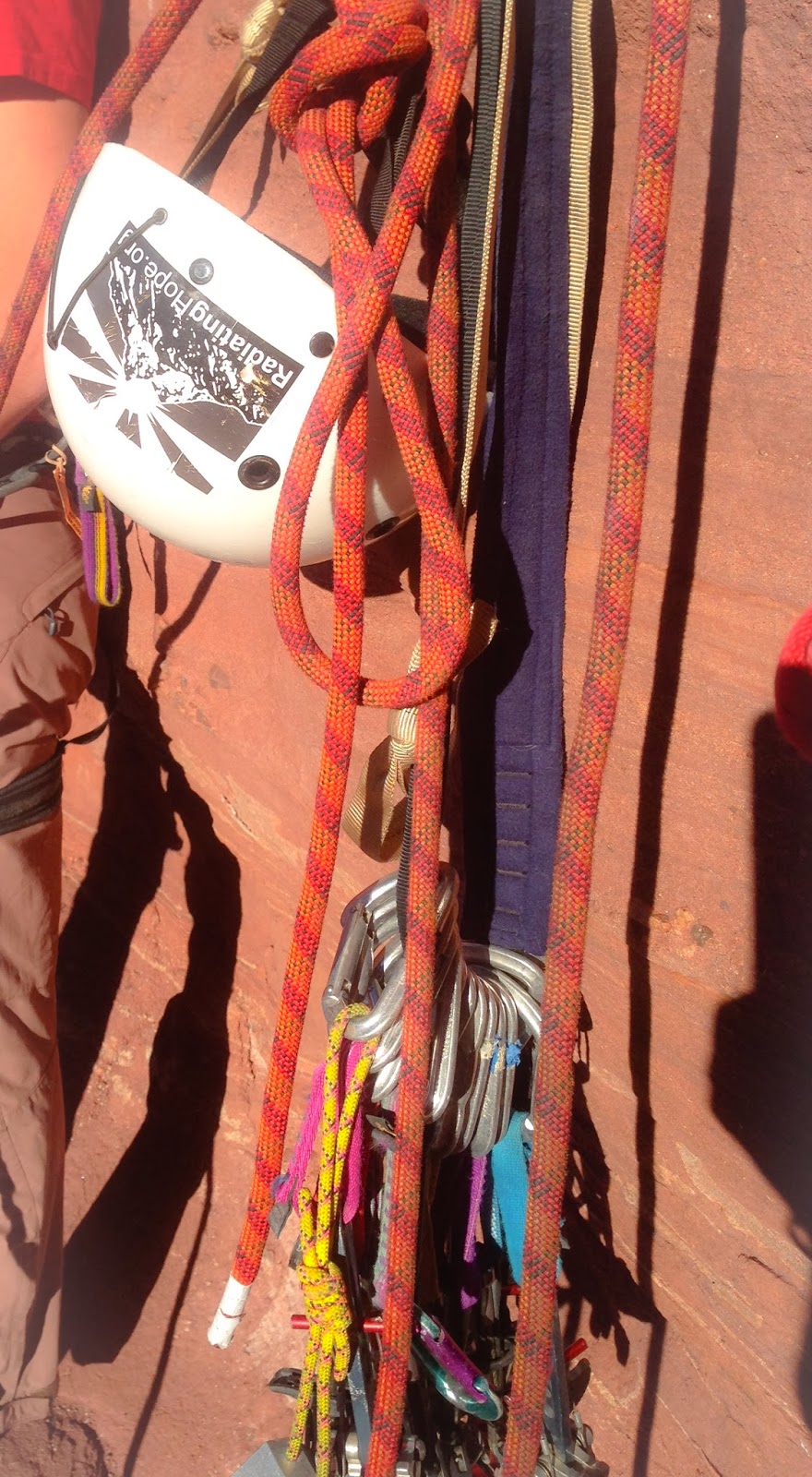
Where are your flags now . . . We are currently preparing to take the Prayer Flags to Mt Kilimanjaro, Africa, this March 2014 and then off to Mt Denali, USA, in May 2014. In preparation to get your flags to the highest peaks around the world, we continue to train so that we will be up for any obstacles that we encounter on our expeditions. Some of our training includes climbing rocks, and there is no place better for climbing to amazing summits than the sandstone towers of southern Utah. This month we took your flags to the airy summits of the Fisher Towers. 

Prayer Flags at the Fisher Tower's, near Moab Utah


A view of the daunting Fisher Towers, hundreds of feet up is the corkscrew summit, our goal for the day. 

Just crossing the 500 foot high sidewalk in the sky

At the summit of the famous corkscrew on the top of the Fisher Towers.

In a setting of unrivaled natural beauty, there is nothing as aesthetic as a slender sliver of chocolate sandstone and nothing as exhilarating as standing atop it. The summit does not come easy, few tower routes are easier than 5.10 (difficulty rating for climber, 5.10's are hard), but what better place to take your flags. We let a few threads blow into the wind on this trip. While mountaineers have to slog up thousand-foot snowfields, glaciers, while pushing through wind, snow and ice storms to get that glory, desert climbers jam, and pull their way up a couple of hundred feet of rock. Not a bad trade off! We wish you all the best as you tackle your daily obstacles and reach your various summits, know we are thinking of you all!! 

The Rooftop of Europe


Elbrus is the highest mountain on the European continent, standing at 18,541 feet above level, and is the third of the seven summits that your flags will travel to the top of. This was a whirlwind trip. . . We flew into Moscow, and quickly jumped on a second plane which took us two hours south of Moscow, near Georgia. From there we took a three hour van ride to the base of the Caucasus mountains, a rather small mountain range with huge, rocky, intimidating peaks, many well over 15,000 feet. 

Prayer flags on Mt Elbrus.

Upon arriving in the Caucasus mountain we could not see Mt Elbrus due to the poor weather conditions, that first day in the mountain range we pushed forward to Basecamp, at nearly 12,000 feet. There, we slept in large barrels that sleep seven people (the number on our team), and they even have electricity, very unique. From basecamp we went on two acclimatization hikes up to about 16,000 feet. After two nights at Basecamp we felt ready to tackle the summit.

A view of the Base camp, after an acclimatization hike. 
The summit attempt started at 3am, we didn't sleep that well and waking up at 3 was not too hard. We put on our gear, crampons, ice picks, severe weather clothing and heading out into the subzero weather with up to 50 mile an hour winds. The climb was steep and at times we felt like we were climbing straight up the mountain. We could barely catch our breath due to the limited availability of oxygen. Our pace was slow and steady. One of our team members got severe altitude sickness with nausea and vomiting, however was able to push on. After 10 hours of hiking, we made it to the top. We spent a minute or two at the top, but due to the pounding wind and cold temperatures we quickly got off and back down the mountain. Your flags made it to the Top!! Having your flags make it to seven of the hardest places in the world as a symbol of our commitment to you and all you have gone through. We want each thread that represents a thought of health, strength and well being in your behalf to be symbolized in the remote corners of this planet.

RadiatingHope climbers at the top of Mt Elbrus!! 

Deep into the Arctic


Larry on his dog sled, deep in the Arctic, draped with prayer flags.


Not only have your flags traveled to the top of mountains around the world, but they have also traveled to some of the most desolate and difficult places to get to on earth, such as the deep Arctic tundra. The cancer journey is not easy, and we want these flags to be a symbol of your journey. Our cofounder, Larry Daugherty MD, carried your flags to the deep arctic with a dogsled team. Larry has wanted to race a dog sled in the deep snow of the Arctic since he was a child. Now living in Florida and working at the Mayo Clinic as an oncology doctor, this dream seemed liked it would never come true. While attending an international conference, he chanced upon a tiny ad from a European cold-weather gear maker Fjällräven. The ad invited people to apply for a highly competitive opportunity to lead a dog sled team into the arctic. Well. . . He won the contest that puts him at the head of a team of huskies.
Larry traveled more than 185 miles across the Arctic tundra between Signaldalen, Norway, and Jukkasjärvi, Swedish Lapland. He was on of 20 people who amde the journey, and was the first American who has invited to join the Fjällräven Polar team. He traveled over tundra, mountain forests and frozen lakes. He camped under the stars, guided by the Northern Lights.
Larry felt decorated his dog sled with many of your flags and was inspired to push forward from all your many stories. We honor you all on this journey!!!!


The Arctic Tundra. . .


Chukkung Ri, Nepal


Kristin Sumbot, a cancer survivor and Radiating Hope representative, took on the Himalayas, taking your flags to new heights! She participated with Above and Beyond Cancer, a nonprofit out of Iowa, in her own words. . .

"Chukkung Ri sits at 18,238 feet in the Everest, Khumbu region of Nepal. We all set out together and then slowly spread out at our different paces. I had found myself walking alone, and the physicality of the hike was getting the better of me. I was struggling to catch my breath in the harsh mountain wind. I wanted to turn back. But I remember thinking I am not a quitter! If I were, then I wouldn’t be here. If I could survive cancer and high dose chemotherapy, then I could do this! The mountains surrounding us were like majestic sleeping giants.  resonated the whole valley with a quiet reverence. As I reached the group, our leader, Dr. Demming, greeted me with a big hug saying, “You are so strong, I am so proud of you.”

As I gazed out into the mountain valley a wave of self recognition hit me. I had come full circle with having cancer. I used to feel that cancer had made me a stranger to myself. After cancer I had a glimpse of who I had become; strong, confident, seeing life in a new way. But I still had insecurities. Living a full life was something that I wanted and pursued. However the traumatic scars left behind from cancer made it hard for me to do so The reward of completing the physical challenge of Chukkung Ri disproved my doubts, and erased those insecurities.

I was looking out at who I had become and the life that I could live if I could embrace the trials and adventure that come with it. Cancer had closed all the right doors and pointed me in the direction of how I wanted to live life. And it does feel like you are on top of the world." -Kristin Sumbot

Mt. Aconcagua, Argentina


Mt. Aconcagua is the highest mountain in the world outside of Asia, standing at an impressive 22,840 feet above sea level in the Andes mountain range. The success rate for reaching the summit is approximately 30%. We spent the past year training as much as possible to prepare for this 18 day expedition.

The trip began by flying into Santiago Chile where we dropped off art supply care packages to the local pediatric cancer children’s hospital. We then flew to Mendoza, meeting our guide, Juan Tomaselli, a local from Buenos Aires. After a several hour bus ride, weaving our way into the Andes Mountains, we came to Puente del Inca, at 9,185 feet, where we spent the first night on the mountain. From here we unloaded a good portion of our gear to be carried to base camp by a team of mules, and began our trek to base camp. It took three more days and more than twenty miles of walking before we reached base camp, spending two nights in Confluencia at about 11,000 feet. It was during these first few days that we caught a glimpse of just how massive Aconcagua is, this mountain stands high above the Andes with a steep, glaciated south face which is very intimidating.


On day 7 of the expedition we made it to Base camp—Plaza De Mulas (below four pictures), at 14,200 feet and stayed here for three night acclimatizing, which consists of climbing high and sleeping low and carrying our gear in small loads to higher camps. Base camp is a unique place with people from all around the world. There is a helicopter that continually comes in and out of the camp for medical purposes and to drop off supplies. You can use the internet for 15 bucks, buy a coke for five, or even warm shower for 10 dollars. We got our gear the mules had carried, as they could go no higher.

The highest art gallery in the world is at base camp, where artist Miguel Doura sells his paintings. Miguel was impressed with Radiating Hope and stated that he would give 20% of his online sales to our cause and hung a string of our prayer flags which can be seen from his art gallery via a live webcam which updates every three minutes. Go to aconcaguanow.com to check out our prayer flags. It will be fun to watch these flags as they will give you a real time idea of how the flags slowly unravel in the wind, so check out the website to watch the process.

By day 10 of the expedition we were ready for the high camps. The move to high camp I (see above picture) at 16,075 feet, started with a big storm of wind and snow which made climbing a little miserable, but we pushed on and within three hours we were setting up our tents at camp Canada. After only one night in Canada we made our way to high camp II (see below pictures), Nido de Condores (or condors nest), at nearly 17,720 feet. Here we stayed for two nights, spending most of the day melting snow in order to have plenty of drinking water. The view from here was amazing, we could see far into northern Argentina and see all the way to Chile, we were above most of the mountains in the area and the views were absolutely breathtaking (literally).

Next we were ready for the last and final camp, high camp III (see below picture), Colera, at 19,600 feet. We had planned to stay here for two nights, and had scheduled in an additional day for bad weather.Well, when we arrived to camp III on January 10th, the winds were strong and we were forced to quickly make shelter and hunker down for the night, the summit attempt was going to be the next day, but due to extreme weather we had to abort the summit attempt and instead spent the day in our tents hoping that the next day would be better. Two of our strong climbers elected to head back down the mountain due to Acute Mountain Sickness (AMS) from the high altitude.

January 11th started for us with a tap on our tent from Juan at 4:30 AM telling us to get ready as there was a break in the weather and we were going for the summit. The wind was still strong and it was cold, but thanks to good gear (and a special thanks to Sherpa Adventure Gear), we felt up to tackling these final 3,000 feet. Quickly into the climb another one of our climbers was sent back down the mountain with AMS leaving four climbers.

We pushed our way up the steep slopes, concentrating on our breathing and making sure every step counted, this was not easy. To quote David, “this was beyond difficult,” and in the words of Alex, “this is by far the hardest thing I have ever done.” We were elated to make it to the top of the Americas, 22,840 feet!!!!