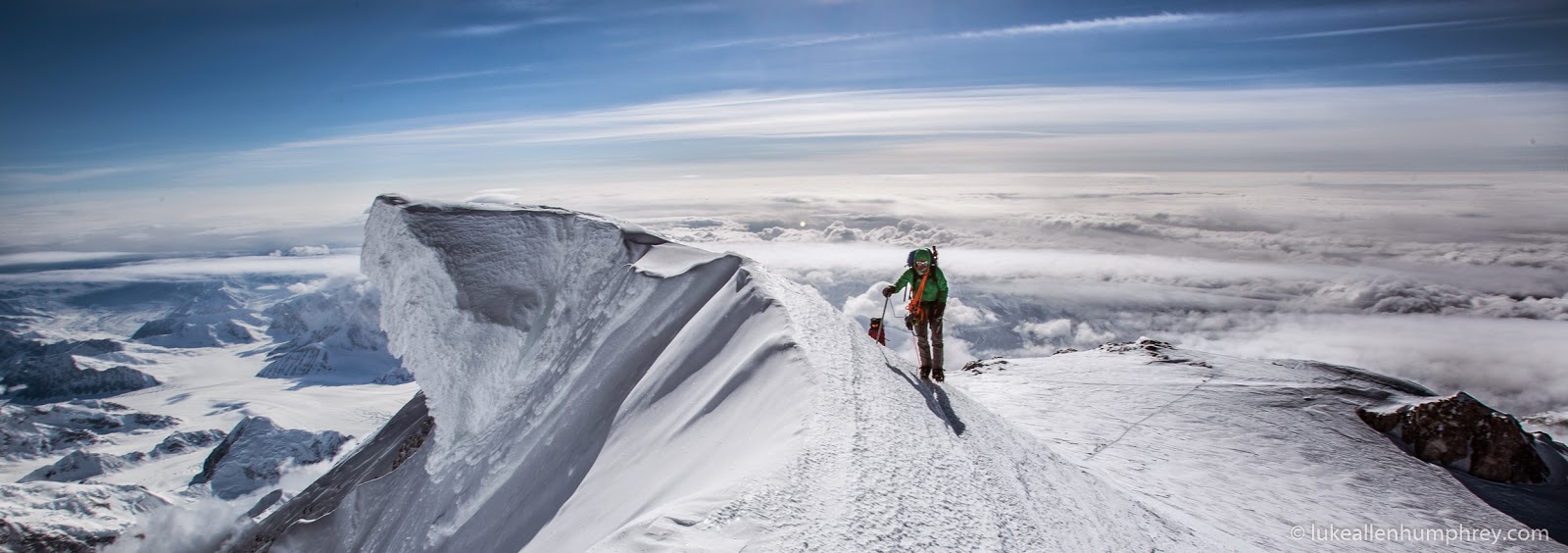
The summit of Mt Denali stands at 20,320 feet. Here is a day by day overview of our expedition.
Day 1: Shortly after arriving in Talkeetna (a two hour drive from Anchorage Alaska), we were debriefed by the Denali park ranger, then jumped on an 8 man plane and flew to the Kahiltna glacier at 7,200 feet. The plane ride took a half hour and was absolutely breathtaking. Rather than spending a night at 7,200 we decided to climb through the night, 5.5 miles, to our first camp site at 7,800 feet. We arrived in camp around 3 pm, set up, made some food and took some much needed rest. We managed to beat a storm that, in the next 5 days to come, would leave almost 100 people stuck on the mountain waiting for an airplane off the mountain.

Denali Day 2: Pushing up the mountain! The average number of days to reach the summit of Denali is 19. Our goal was to get to the 14,200 camp as quickly as possible and then wait for a window to get to the summit. Rather than dropping caches of gear up the mountain (which entails climbing 2,000 or so feet, dropping off a portion of your gear and then descending 2,000 ft or so to sleep, then climbing back up to your gear the next day), we just pushed from camp to camp with all of our gear. On day 2, we went from 7,800 feet to 9,800 feet. We pulled 50-60 pound sleds and carried 40-50 pound packs. Our pace was slow but constant. We arrived at the 9,800 camp right on schedule.
Day 3: 9,800 feet to 11,200 feet. Today we again moved up the mountain. It takes the majority of the day to breakdown camp, pack up, and move up to 11,200 feet--and then set up camp again. "Chores" were all the little things that went into breaking down and setting up a camp. On Denali you must build a fortress of snow blocks around your tent in order to decrease the notoriously horrible weather from beating on your tent- the last thing you want is to break a pole on Denali! We had three tents for our group of 6. We did meet one guy whose tent blew away while we were on the mountain- scary...
Denali Day 4: Motorcycle Hill to Squirrel Hill and back again. Rather than pushing to the next camp (14,200 feet) we elected to stay another night at 11,200 and drop a cache two thousand feet up the mountain. Today we approached one of our first major obstacles: Motorcycle Hill. This steep section required us to cross several crevasses and really put our crampons to the test, as we had to dig them in securely against the steep mountain terrain. As we looked up at the mountain towards our goal for the day, we could see heavy winds and were hoping we could push through them. We managed to navigate the weather for a couple of hours, but, as we came around the steep and mildly exposed squirrel hill, the heavy winds finally beat us down and we returned to the 11,200 camp, leaving our cache of gear around 12,500 feet. We estimated the winds to be around 50 mph.

Day 5: Keeping the pace! 11,200 feet to 14,200 (high base camp). Today we pushed to the 14,200 foot camp, also known as high base camp. Here we waited for a good weather window before pushing to our last camp (17,200 feet) and then to the summit. Getting to 14,200 feet is no easy task. It requires again climbing Motorcycle and Squirrel Hill, but also going around Windy Corner with all of our gear. This portion not only lives up to its name, on parts of the climb our sleds slid into the crevasses and were constantly being pulled down the hill at a 90 degree angle from the direction we were heading. To put this in perspective- try climbing a hill with a backpack on while someone is pulling on your right side with about 70 pounds of pressure and try to walk straight on, then add some wind and drop the temperature to about 0. We rolled into the 14,200 foot camp exhausted. We also came to learn that this year was considered to be one of the stormiest years on Denali, with summit rates around 15% (they are usually around 50%). We met many people who were turning around and others who had been at the 14,200 foot camp for up to 3 weeks- ouch! We knew our chances were highly dependent on the weather, which was why we pushed to make such good time to the 14,200 foot camp. This would put us in perfect position if a good weather window opened. We made it to the 14,200 foot camp in 5 days (it usually takes groups around 10 days). Let's hear it for our team!!
Denali Day 6: Rest and Recovery. Today we spent the day at 14,200 feet camp (camp 3 on the map below). This was a perfect day to rest, even if we wanted to go higher up the mountain we could not. We learned from the ranger that this had been the worst year to summit Denali, with summit rates in the teens. Heavy storms and high winds had basically shut down the mountain above 14,200. We could hear the heavy wind raging above, it sounded like Niagra Falls. We stayed hopeful that we might be fortunate to get a weather window in the next week or two. Many groups at the 14,200 camp were turning around after three weeks of waiting for the weather window and never getting it. Today we fortified our camp, fixing some of the snow blocks, digging out our tents from time to time and also hung up a few prayer flags.

Denali Day 7: Today looked something like this. . . snow, wind, poor visibility. We spent the day in our tents. Occasionally the clouds would break, but this was short lived. We listened to books on our ipad, read books, painted, and melted glacier snow to get our water for about 4 hours a day. Mainly we just tried to keep warm. Denali is cold! The coldest temperatures we saw were -38 F with the wind chill.
Denali Day 8: Another day at 14,200. Still no weather window, more teams turned around. Here are some photographs taken by Luke of our 14,200 foot camp, lukeallenhumphrey.com. Check out the bird's eye view of the 14-camp-- spectacular!
Denali Day 9: Yet another day at 14,200 feet- waiting and surviving. At this moment more groups turned around without making it to the top . . . We did get word of a possible decrease in the winds.

Denali Day 10- Today we got a message on the satellite phone that
the winds have decreased and that they might continue to decrease for the next
two days-- before the next big storm moved in. This might be our only chance,
so we decided to move up to the last high camp at 17,200 feet (three thousand
feet up the mountain). This was not an easy move. We took three days of food
and hope for a weather window in the next two days. Getting to 17,200 feet
requires that we scale a gigantic 2,000 foot wall- they simply call it the Headwall
(see Luke's picture of Cecil on the headwall). Once on top of the Headwall, we
cross a knife-edge ridge (west buttress ridge) with a two thousand foot drop on
one side and a three thousand on the other (see pictures of climbers on ridge
below). Once we got up the Headwall the winds began to pick up on the ridge
again, making crossing the ridge almost impossible. Due to the long lines on
the Headwall, where climbers were waiting to get on a single-file fixed rope
line, our two rope teams got separated by about one hour. Our first rope team
was allowed to get ahead of a guided group and were able to get on the fixed
rope line ahead of the other group, which placed them on the ridge an hour
ahead of the other. This wasn’t a safe place to wait, so the first rope team
pushed on, making it to the 17,200 foot camp exhausted. Luckily they were able to get their shelter
setup before even heavier winds set in. Our second rope team of three got
caught in the heavy winds and elected to set up an emergency shelter at 16,000
feet, where they spent the night. Fortunately we were able to communicate with
radios and knew exactly what each team was doing. We fell asleep to the sound
of the wind rattling our tents. . . You have to check out Luke's pictures from
the Headwall and West Buttress ridge.


Day 11: More Denali bad weather, does it ever end?! Today the weather was so bad that we spent the day in our tent at 17,200 feet. Our tents didn't stop rattling all night long. Finally, around noon they began to settle down...just a little. Our second rope team of three was able to make the push through the winds to join us at the 17,200 camp, making us a team of 6 again! The weather report stated that the next day the clouds would part, the winds would die down, and we might have an opportunity to climb to the summit. Edmund Hillary said, "You don't conquer a mountain. If you are lucky enough, the mountain will give you the chance to stand on the top." We were now in the position for a summit attempt, just hoping for that brief window. . . hoping to get lucky. . .
DENALI DAY 12: THE SUMMIT- Rooftop of North America
Today the clouds parted and the winds died down. This was our weather window (pretty much the only weather window to summit Denali up to this point of 2014--and pretty much the only one since). Edmund Hillary said, "It is not the mountain we conquer but ourselves." After 12 days of fighting intense storms, freezing cold weather, fatigue, high altitude, steep and icy cliffs and ridges, we made it! We were lucky enough to get to stand on the top of Mt Denali- through the adversity we felt more alive. Many climbers get emotional at the top, as a rush of overwhelming emotion hits them- life seems to make the most sense for some of us on top of mountains- it all comes together, and for that moment we become enlightened and become better people because of it. This is similar to any time we face and overcome adversity and challenges in life- at the end of a challenge--at the peak, it all comes together and makes sense and we progress. We were honored to fly the Radiating Hope prayer flags in honor of our cancer patients, and the mountains they climb each day of their treatment.
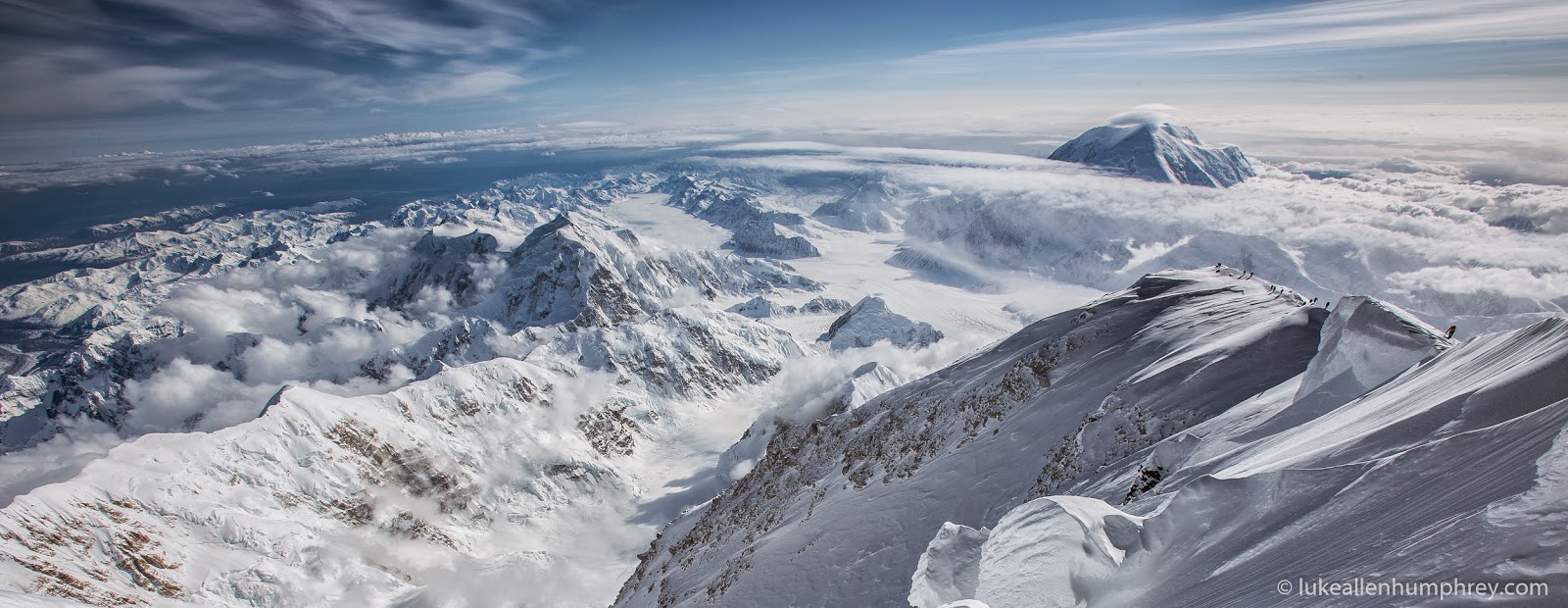
Denali Day 13: 17,200 to 14,200 ft. Today we begin our 16 mile, several thousand foot descent off Mt. Denali. Most accidents on mountains happen on the descent, so we carefully made our way down. We arrived at camp around 2 pm with plans to eat some food, melt some snow, and replenish our water supply and then take a nap until 10:00 pm. At 10 pm we woke up and packed one last time, and then at midnight, we started our journey to 7,200 feet, hoping to catch the morning plane ride off the glacier.
Day 14: Today we hiked from 10:30 pm, through the night, until 9:30 am, arriving at the air strip. We caught an afternoon plane and were off the glacier by 3:30 pm, back in Talkeetna. . . back to Anchorage, and back home. . .
All these amazing pictures are by Luke Humphrey- check out his work and order prints at LukeAllenHumphrey.com

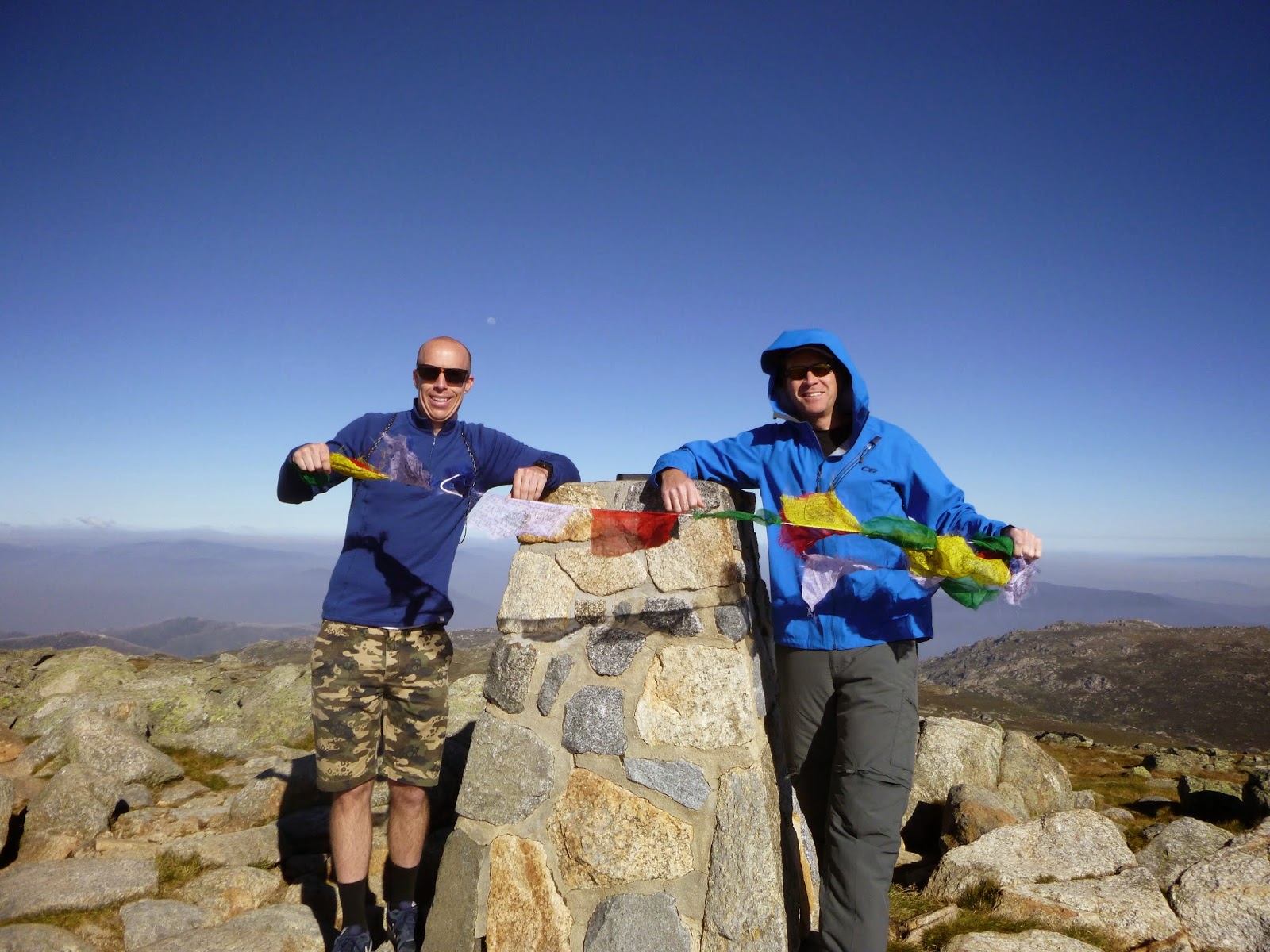


 The Teton Range is a mountain range of the Rocky Mountains in North America. The Grand Teton, located in Wyoming, is the highest mountain in the range, and the second highest mountain in Wyoming at 13,770 feet. The Grand Teton is a technical mountain requiring rock climbing/alpine climbing skills to reach the summit. Early French Voyageurs used the name les trois tétons (the three breasts). In July 2014 Brandon Fisher climbed the grand teton with pink prayer flags in honor of all the breast cancer patients he has treated over the years. The flags were handmade in Nepal through a company called dharmashop.com. it is customary for Brandon to dedicate flags in his patients honor and even given them a string of flags. Brandon is an oncologist who gets strength from his patients. “I watch these patients take on their cancer, they fight for life, they show me each day that life is worth fighting for and that we need to take advantage of each moment we are alive, love our kids, spouses, and strive to create meaning in everything we do, these patients are my inspiration to push on, they are so strong."